

Last Updated on February 13, 2026 by Jim Benson

Personal Kanban doesn’t replace the way you think about work. It makes the way you think about work visible.
Personal Kanban has two rules: visualize your work and limit your work in progress. That’s it. We designed it this not because we were lazy, we wanted it to adapt to whatever already works for you.
Your brain has already figured out how it likes to sort things. We’re here to get it out of your head and onto a surface where you can actually see it, question it, and improve it.
Eva Schiffer showed us years ago exactly what this looks like in practice when she wrote:
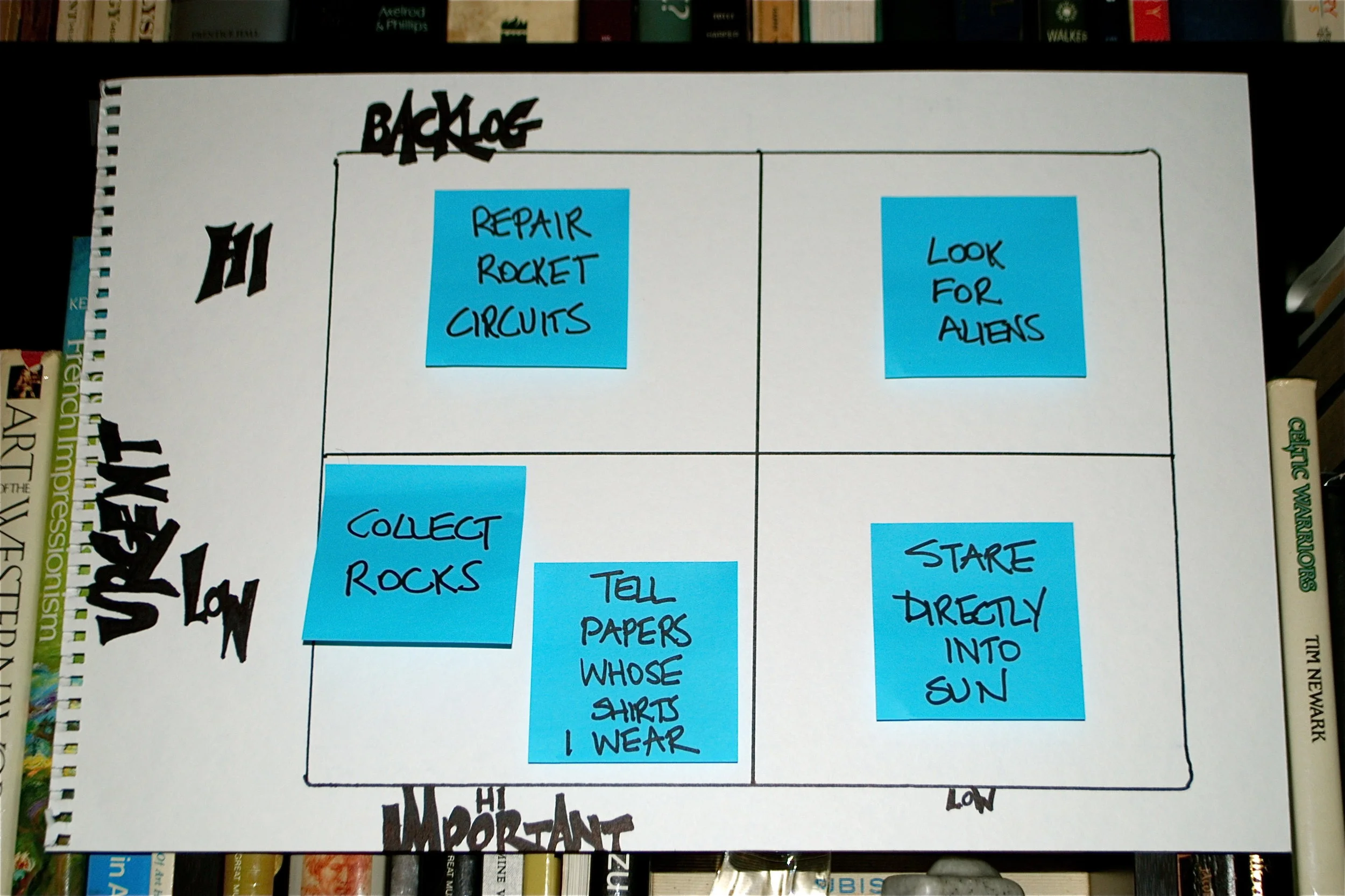
I have just erased my to-do list and transformed it into something kanban-like. My own to-do list format, that always worked well for me, had four categories: Important and urgent. Important, less urgent. Less important, urgent. Less important, less urgent. That helps me a lot because I normally love the less important, less urgent tasks, and while they often lead to really interesting creative outcomes, it is important for me to keep procrastination at bay and make sure that I don’t just impress myself with the number of tasks performed, but also do those things that are most urgent and/or important.
Eva identified something most people never notice: she was productive without being effective. She was completing tasks at a satisfying clip — but the tasks she gravitated toward were the fun, creative, low-stakes ones. The important work sat there, undone, while she impressed herself with volume.
Sound familiar?
The Difference Between Productivity and Effectiveness
Productivity is throughput. How many things did you finish? Effectiveness is impact. Did you finish the right things?
A board full of completed cards feels great. But if those cards were all low-importance tasks you knocked out to avoid the hard stuff, you’ve built a monument to procrastination. Visualization makes this pattern impossible to hide from. When your board shows you exactly what you completed and what you avoided, effectiveness becomes a conversation you have with yourself every day.
Eva’s four-category matrix — urgent/important, urgent/less important, less urgent/important, less urgent/less important — is Eisenhower’s matrix. It’s Covey’s four quadrants. It’s one of the most proven frameworks for separating what matters from what’s merely loud. And it works beautifully inside Personal Kanban.
Your Matrix Inside Your Kanban
Eva’s instinct was right: you don’t have to abandon the matrix to use a kanban board. You bring the matrix into the board.
Your backlog doesn’t have to be a single flat column. It can be organized as a 2×2 grid, as color-coded cards, as swimlanes — whatever makes the urgent/important distinction visible at a glance. The point isn’t the format. The point is that when you look at your board, you can immediately see: Am I about to pull something important, or am I about to pull something comfortable?
This is also where the Priority Filter comes in. The Priority Filter is a three-stage backlog — P3, P2, P1 — with shrinking WIP limits that funnel work toward action. Eva’s matrix and the Priority Filter aren’t competing approaches. They’re complementary. The matrix helps you evaluate. The filter helps you commit. Use the matrix to decide what’s important. Use the filter to make sure the important stuff is what you actually pull next.
Why Context Changes Everything
Here’s the part that static prioritization systems miss: importance shifts.
Today, home repair is low on your list. After a tornado, it’s the only thing on your list. Did you decide that? No. Life did. Context shifted, and your priorities shifted with it.
This is why just-in-time reprioritization matters more than any one-time ranking. A priority list you made on Monday morning is already wrong by Monday afternoon. Something new landed. Something old resolved itself. Someone changed a deadline. The world moved.
Personal Kanban handles this because your board is always in front of you, always editable, always honest about what’s actually happening right now. You can reprioritize in real time — moving cards between columns, promoting and demoting, pulling something unexpected straight into Doing because the context demands it.
The urgent/important matrix gives you the criteria for judging. Personal Kanban gives you the surface for acting on that judgment, continuously, as things change.
The Trap of Impressive Volume
Eva’s self-awareness deserves attention because it names a trap most of us fall into without realizing it.
The less-important, less-urgent tasks are often the most enjoyable. They’re creative. They’re low-risk. They’re completable in a single sitting. And every time you finish one, your brain gives you a little hit of accomplishment. So you do another. And another. And at the end of the day, you’ve finished twelve things and none of them mattered.
Meanwhile, the important work — the proposal, the difficult conversation, the strategic decision — sits untouched. It’s harder. It’s ambiguous. It doesn’t fit neatly on a sticky note. And so it waits.
Existential overhead — the cognitive tax of carrying undone important work — grows heavier every day you avoid it. The irony is that by staying “productive” with small tasks, you’re making the important tasks feel even more impossible. The avoidance compounds.
The kanban board makes this visible. When your Done column is full of green cards (low priority) and your Doing column has no red cards (high priority), the board is telling you something. Not judging. Just showing you the pattern, so you can choose differently tomorrow.
Be Like Eva
Eva didn’t throw out her matrix. She didn’t abandon the way she’d always organized her thinking. She took what worked — a framework that helped her distinguish urgency from importance — and put it on a surface where she could see it, limit her work in progress, and stop fooling herself with volume.
That’s the whole idea. We’re all individuals. Quality, value, and growth are different for each of us. Not only that — they’re contextual. What matters changes as life changes. The system that serves you has to change with it.
So find the way you define your work. Visualize it. Limit it. And then ask the question Eva had the courage to ask: Am I being productive, or am I being effective?
Personal Kanban was created by Jim Benson and Tonianne DeMaria Barry. Explore the Priority Filter tutorial, the full archive of design patterns, and more at personalkanban.com. and in the book Personal Kanban.
Related reading:




Kanban Oddity? 😉
[…] help you detect some patterns in your actions. One tool I offered to structure your backlog is the personal kanban matrix. Using the four quadrants to determine urgency and importance of tasks really helps you to realize […]
[…] help you detect some patterns in your actions. One tool I offered to structure your backlog is the personal kanban matrix. Using the four quadrants to determine urgency and importance of tasks really helps you to realize […]
[…] and I took the most important and urgent tasks from my todo lists onto the board. I used a form of priority filter, with a generic todo column to the left, then a “soon”/today column, then the usual […]