Last Updated on February 16, 2026 by Jim Benson
The quality of art is that it makes people who are otherwise always looking outward, turn inward. ~ the Dalai Lama
There’s a certain irony in the fact that knowledge workers are often afforded little time to do what it is they are enlisted to do: think.
In an era defined by constant connectivity, information overload, ceaseless distractions, and the perfidious fetishization of multitasking our days, our processes, our modus operandi is increasingly becoming reactive.
The Fast Thinking Trap
Our “fast thinking brain” as Daniel Kahneman refers to it, helps us wend our way through this neural noise with the aid of subconscious shortcuts or, cognitive biases. So we traverse our lives myopically through a sequence of habits, intuition, emotions, one assumption after the next, to the point that our focus turns to frenzy and the output of our work precludes us from taking a serious and vital look at what inputs affect it.
Over reliance on this fast, shortcut-driven “system one thinking” can compromise our understanding of what it is we’re actually doing, and why.
For innovation, for improvement, for personal fulfillment, this type of workflow is not sustainable.
Why Shortcuts Matter (And When They Don’t)
Science estimates the human brain processes on average between 50,000-80,000 conscious and subconscious thoughts per day, and so reliance on heuristics is both an efficient and necessary use of our brainpower.
But it’s not always effective.
That’s because these shortcuts – the assumptions that drive us – are not always correct.
Breaking the Cycle: The Power of the Pause
In an age of overload, what happens to the brain when we silence the neural noise and take a moment to simply pause to consider what we are really doing, and why?
Unplugging, incorporating ritualized pauses into the workday breaks the cycle of assumption, shifting us from the emotional, to the rational “slow thinking brain.”
Disengaging and taking a cognitive time-out engages our “system two thinking,” shifting our consciousness from the habitual, the reptilian, to the intentional, helping us solve problems thoughtfully, make decisions more deliberately, and generate new ideas.
Making It Real: Add “Thinking” to Your Personal Kanban
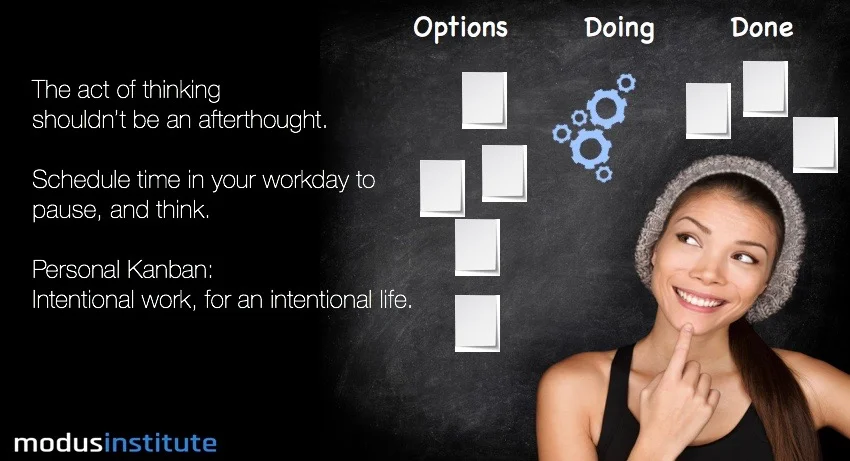
Looking for more EUREKA! moments? Add a “Thinking” ticket to your Personal Kanban.
Unplug. Look out the window. Take a walk. Break the cycle of reaction by tapping into your creative mind.
This article was inspired by a conversation with Maggie Churchville.
Continue the Conversation
Want to explore these ideas deeper with our community?
📅 Join our upcoming events and workshops – Connect with other practitioners exploring humane work practices, visual management, and sustainable productivity.
📬 Subscribe to our newsletter: Humane Work – Get weekly insights on building work systems that respect human capacity while driving real results.
At Modus Institute, we believe work should enhance life, not diminish it. Learn more about our approach to visual management and humane work systems.




Leave A Comment